Why Conversational AI in Collections Requires System-Level Governance
The deployment of conversational AI in collections has progressed beyond experimentation. AI voice systems are now interacting with consumers, handling payment conversations, and influencing operational outcomes at scale. Despite this progress, many organizations continue to approach AI deployment as a feature evaluation rather than a system-level design challenge.
From an operational standpoint, collections performance is determined by workflow structure, escalation logic, and decision ownership. Conversational AI succeeds only when it is integrated into these existing systems with clear constraints and governance. When deployed without this framework, AI introduces unpredictability rather than efficiency.
The central opportunity presented by conversational AI is not automation alone, but the ability to redesign operational capacity in a way that supports compliance, predictability, and scale without adding headcount.
Conversational AI Functions as a System Component
Conversational AI in collections should be evaluated as a system component rather than an interface. While conversational fluency is important, it is not the primary determinant of success. Predictability, constraint adherence, and escalation behavior play a far greater role in operational outcomes.
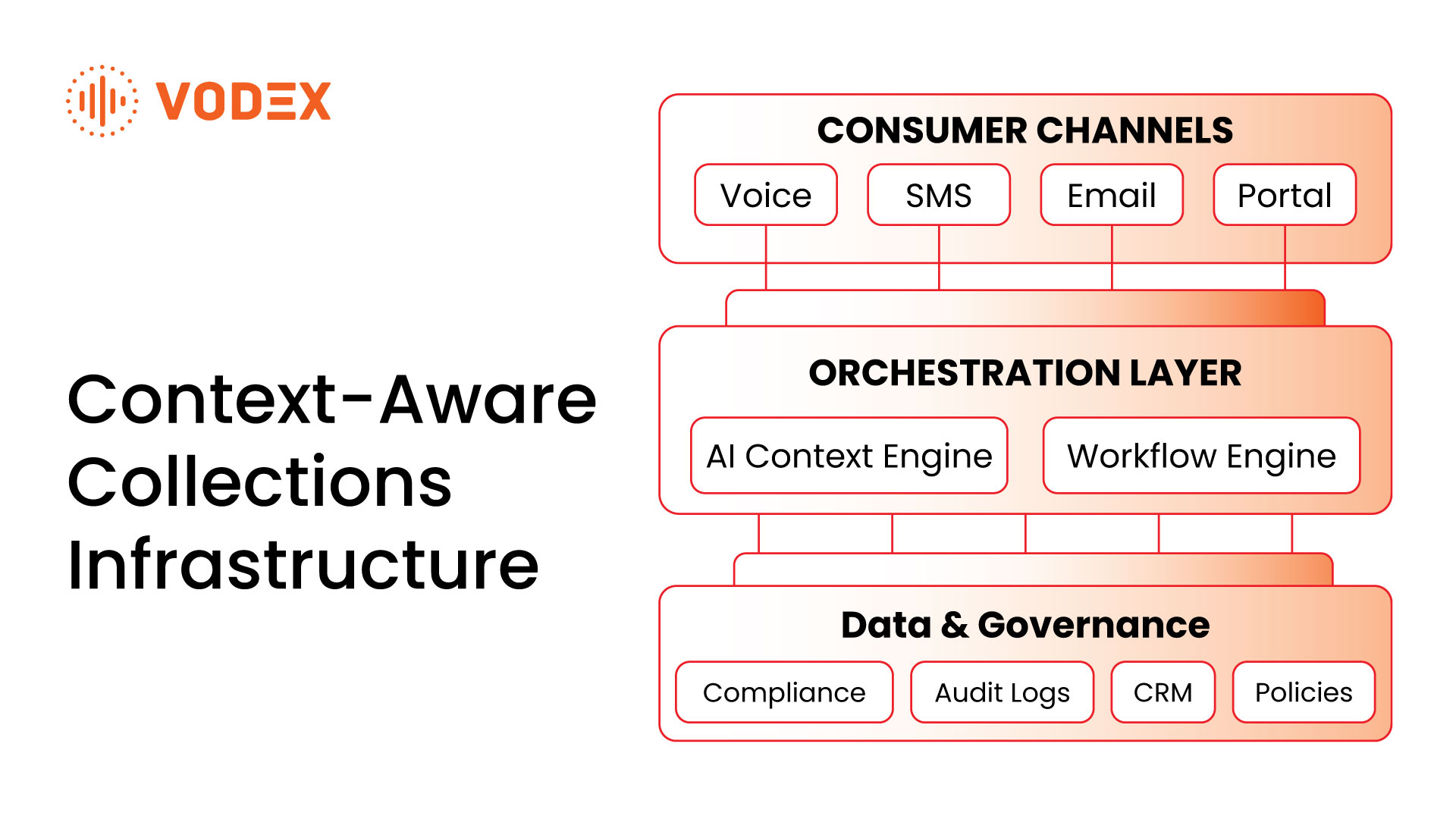
Collections operations already rely on structured systems. Calls are routed based on account status, collectors operate within defined boundaries, and certain outcomes are explicitly prohibited. Conversational AI must operate within the same framework to remain governable.
When AI voice is treated as an interface, behavior becomes inconsistent and difficult to audit. When it is treated as a system component with defined inputs, allowable actions, and termination conditions, it becomes predictable and manageable at scale.
AI Voice as a Governed Payment Channel
Using AI voice as a payment channel introduces governance requirements similar to those applied to email, SMS, and digital portals. Payment channels are not experimental assets; they are controlled mechanisms with defined rules and accountability.
AI voice systems must therefore be designed with explicit limitations on what can be presented, how payment options are introduced, and when escalation is required. This approach reduces risk exposure by ensuring consistent behavior across all consumer interactions.
Well-governed AI voice systems often exhibit greater consistency than human-driven interactions, particularly in high-volume environments. Governance does not restrict capability; it enables safe scalability.
Compliance Guardrails as Architectural Design
Compliance guardrails for AI collectors must be embedded at the architectural level rather than layered on through scripts or post-processing controls. Collections compliance is a continuous lifecycle involving consent recognition, intent detection, escalation, and resolution.
Effective guardrails rely on the system’s ability to recognize non-goal states and trigger predictable responses. These responses may include transfer to a live agent, termination of the interaction, or suspension of further engagement.
This approach mirrors best practices in human collector training, where escalation thresholds and prohibited behaviors are clearly defined. When implemented correctly, AI systems become more auditable and consistent than manual processes.
Inbound Use Cases as Controlled Learning Environments
Inbound interactions provide the most controlled environment for conversational AI deployment in collections. Consumer-initiated contact results in higher intent, lower friction, and more stable behavioral patterns.
Inbound AI deployments enable organizations to observe how consumers respond to AI voice under realistic conditions while limiting compliance exposure. After-hours collections automation extends this benefit by capturing demand that exists outside traditional staffing windows.
These environments allow organizations to validate system assumptions, refine escalation logic, and establish internal confidence before expanding AI usage to more complex scenarios.
Outbound AI Requires Distinct Operational Strategy
Outbound AI collections strategy presents a fundamentally different challenge from inbound deployments. Outbound interactions introduce voicemail management, uncertain right-party contact, and lower baseline engagement.
Successful outbound AI systems are designed to filter and qualify rather than close. The AI’s role is to identify viable conversations, manage rejection gracefully, and prepare context for human intervention.
This division of responsibility preserves human effort for scenarios requiring judgment, negotiation, and empathy while allowing AI to absorb high-volume, low-probability interactions.
Scaling Without Adding Headcount Through Work Reallocation
Scaling collections without adding headcount is achieved through work reallocation rather than increased individual productivity. Conversational AI absorbs repetitive calls, after-hours demand, early qualification, and language routing.
As a result, human collectors can focus on complex negotiations, higher-balance accounts, emotionally sensitive conversations, and true exceptions that require discretion. This shift improves operational efficiency while also affecting training, incentive structures, and workforce sustainability.
From a leadership perspective, this represents a structural improvement rather than a temporary efficiency gain.
Multilingual AI Voice as Structural Enablement
Multilingual AI voice addresses a persistent structural limitation in collections operations. Demand across languages often exceeds the organization’s ability to staff sustainably.
AI enables deterministic language routing and consistent coverage without fragmenting teams or increasing overhead. This capability should be viewed as a core operational function rather than a secondary enhancement.
Structured Data as a Compounding Advantage
Conversational AI systems generate structured data by default, including objection patterns, intent signals, language preferences, and escalation triggers. Over time, this data informs segmentation strategies, outbound timing, and portfolio treatment decisions.
Unlike human-generated data, which is expensive to extract and normalize, AI-generated data is immediately actionable. Organizations that leverage this insight gain a compounding strategic advantage.
Future Outlook
The long-term impact of conversational AI deployment in collections will be determined less by model sophistication and more by system design discipline. Governed systems outperform reactive deployments, and incremental expansion outperforms rapid scaling without controls.
Organizations that embed AI voice into operational architecture rather than attaching it at the periphery will achieve more durable outcomes.
Conclusion
Conversational AI is reshaping collections not because it replaces human intelligence, but because it enforces operational clarity. It requires organizations to define intent, escalation ownership, and acceptable outcomes explicitly.
When deployed as a governed system, conversational AI becomes a sustainable source of capacity rather than a source of operational risk. Leadership decisions, not technology alone, determine the success of these deployments.
Author Bio
Adam Parks has become a voice for the accounts receivables industry. With almost 20 years working in debt portfolio purchasing, debt sales, consulting, and technology systems, Adam now produces industry news hosting hundreds of Receivables Podcasts and manages branding, websites, and marketing for over 100 companies within the industry.