The Role of Language in AI Governance for Regulated Financial Operations
Artificial intelligence has moved rapidly from experimentation to expectation across receivables operations. Collection agencies, debt buyers, and creditors increasingly deploy AI-enabled tools to improve efficiency, scalability, and consumer engagement.
However, many organizations struggle to articulate how these systems function, how decisions are governed, and where accountability ultimately resides.
At the outset, it is worth noting that this perspective is informed by direct operational experience integrating technology within regulated financial environments. That said, the governance challenge extends far beyond any single organization or role.
The core issue is structural. Artificial intelligence terminology in collections has become imprecise. Rules engines, machine learning models, analytics platforms, and large language models are routinely grouped under the same label. When distinctions disappear, governance mechanisms weaken.
In regulated industries, that weakness manifests as compliance exposure, operational fragility, and misplaced confidence in automated systems.
Before AI can be governed effectively, it must be defined accurately.
Artificial Intelligence Is Not Intelligence in the Human Sense
A persistent misconception within AI discussions is the belief that artificial intelligence systems think or reason in ways comparable to humans. While this analogy may be intuitive, it is technically inaccurate and operationally risky.
Human cognition relies on an adaptive electrochemical process capable of reasoning, judgment, and intent. Neural networks in computing, by contrast, are statistical systems. They generate outputs based on probability distributions derived from training data rather than understanding or awareness.
In collections environments, this misunderstanding often leads to inappropriate delegation of authority. AI-generated outputs begin to be treated as decisions rather than inputs, eroding accountability. When systems are perceived as intelligent actors, responsibility subtly shifts away from human oversight and into software processes that cannot assume liability.
Artificial intelligence terminology in collections must clearly differentiate between predictive models, deterministic logic, and generative systems to prevent this erosion of responsibility.
Large Language Models vs Deterministic Systems
The distinction between large language models and deterministic systems represents one of the most critical governance considerations in modern collections operations.
Deterministic systems are engineered for predictability. Identical inputs yield identical outputs, enabling auditability, compliance validation, and regulatory defensibility. Large language models operate differently. They are probabilistic by design, generating responses based on likelihood rather than certainty.
Variability is therefore not a defect within large language models. It is an inherent characteristic. The governance challenge arises when probabilistic systems are applied in operational contexts that require consistency and traceability.
Effective AI governance in receivables operations does not attempt to eliminate probabilistic behavior. Instead, it ensures that variability is constrained to appropriate system layers. Generative systems may assist with summarization, categorization, or conversational support, while deterministic logic retains authority over execution, compliance decisions, and system-of-record changes.
This layered approach reflects a broader governance principle: AI should augment structured decision systems, not replace them.
Governance as an Architectural Discipline
AI governance is frequently approached as a documentation exercise. Policies are drafted, training materials are updated, and escalation procedures are defined. While necessary, these measures alone do not constitute governance.
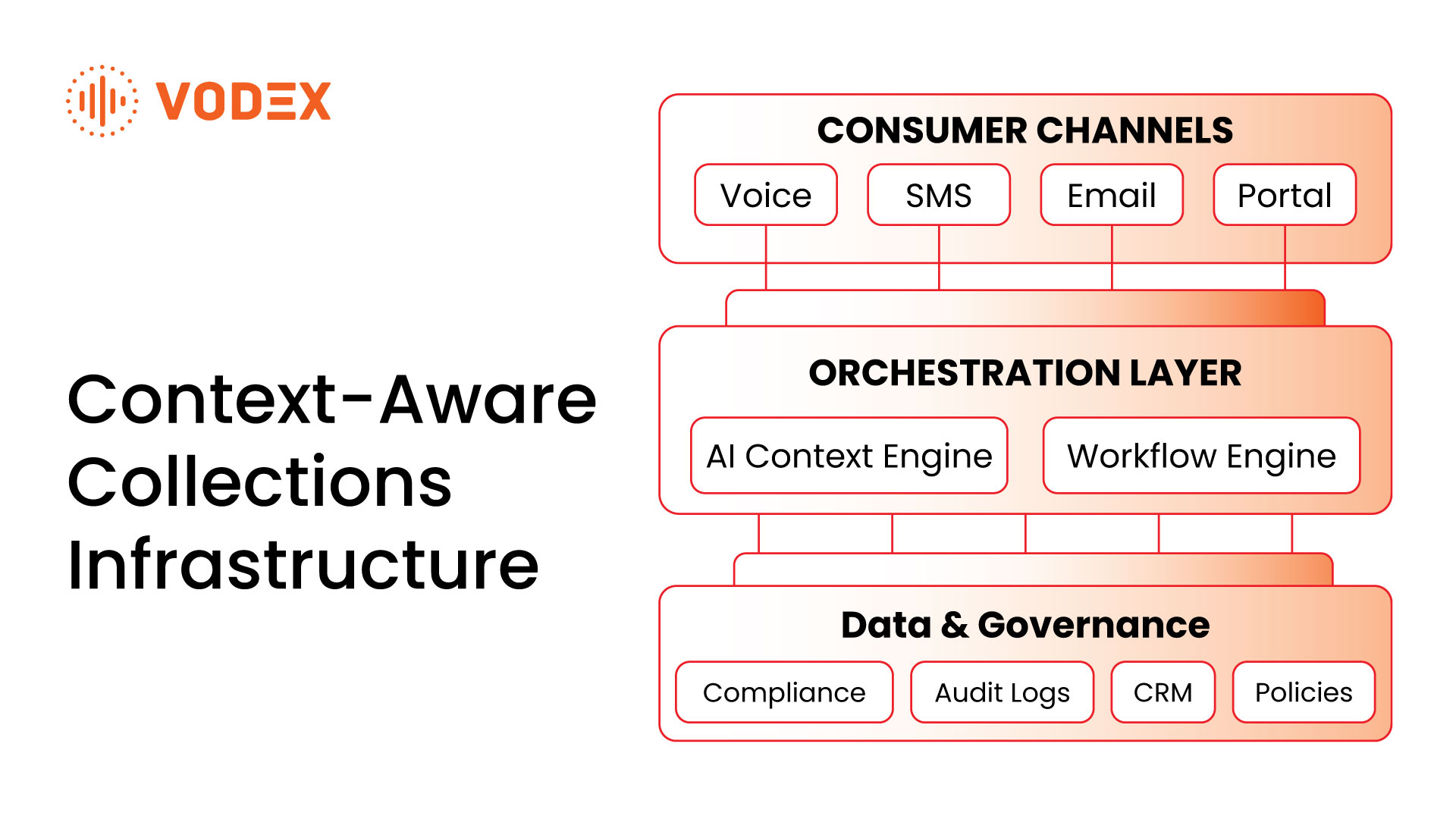
True AI governance in receivables operations is enforced through architecture. It is embedded in system design decisions that determine data access, execution authority, and validation controls.
In well-governed environments, AI systems do not act directly on core operational records. Instead, they operate through controlled interfaces that validate requests against deterministic rulesets. Outputs may be constrained, modified, or rejected based on predefined logic. Human accountability is preserved not through policy enforcement, but through structural design.
This approach reduces reliance on perfect human behavior and replaces it with systemic safeguards capable of operating consistently at scale.
The Myth of Continuous Learning
Another common misconception undermining governance is the belief that AI systems continuously learn from every interaction. While adaptive learning exists in certain narrow contexts, most large language models operate within fixed training parameters supplemented by contextual inputs rather than real-time learning.
This misunderstanding has material governance implications. Organizations that assume continuous learning may underestimate the importance of input quality, monitoring frameworks, and retraining cadence. In reality, AI systems reflect the quality of their training data, constraints, and operational boundaries.
Clarifying this distinction reinforces the need for disciplined oversight. Artificial intelligence terminology in collections must accurately convey system limitations to support responsible deployment and realistic risk assessment.
Integrating AI Into Collection Management Systems
AI integration within collection management systems is no longer optional. However, integration strategy determines whether AI introduces value or amplifies risk.
Efficiency is often cited as the primary motivation for AI deployment. Without adequate controls, efficiency gains may be offset by regulatory exposure, reputational damage, and operational inconsistency.
Responsible integration positions AI as an assistive capability rather than an autonomous actor. AI systems support agents by summarizing information, identifying patterns, and reducing cognitive load. Decision authority remains governed by deterministic controls and human oversight.
This approach aligns with long-term operational sustainability, particularly in consumer-facing environments where tone, timing, and intent carry regulatory significance.
Governance Maturity as a Competitive Differentiator
Across the receivables industry, AI adoption is advancing faster than governance maturity. While experimentation is widespread, few organizations can clearly articulate how AI-driven decisions are governed across their operational stack.
This governance gap represents a competitive opportunity. Organizations that invest in architectural discipline, terminology precision, and accountability frameworks will be better positioned as regulatory scrutiny intensifies.
Artificial intelligence terminology in collections serves as an early indicator of governance maturity. Precision in language enables precision in control.
Conclusion
Artificial intelligence governance does not begin with vendor selection or tool deployment. It begins with clarity. Terminology shapes accountability, system design, and ultimately regulatory defensibility.
Organizations that treat AI as a system component rather than a decision-maker are better equipped to balance innovation with control. As AI continues to reshape receivables operations, leadership will be defined less by speed of adoption and more by governance discipline.
The future of AI in collections will belong to organizations that govern deliberately, architect intentionally, and define precisely.
Author Bio
Rob Grafrath is a Strategic Architect & Industry Orchestration Consultant for CSS Impact and a veteran of the receivables industry with deep experience across collections operations, enterprise systems, and applied technology. He is an active industry voice on AI architecture, governance, and responsible deployment in regulated financial services.