

From Dark Data to Organizational Intelligence
By Bhagyashree Vaidya
Recognizing the value of dark data is only the beginning. The more difficult question is operational: how does a collection organization actually transform years of disconnected conversations, notes, and recordings into a system that continuously improves decision-making?
Most organizations cannot simply deploy a large language model and expect value to emerge. Activating dark data requires a sequence of capabilities that build on one another. Organizations must first gain access to operational data trapped inside legacy systems, convert unstructured interactions into machine-readable information, transform those interactions into behavioral signals, institutionalize the resulting knowledge, and finally govern how that intelligence is used.
The following five-step framework illustrates one practical path.
Step 1: Connect Legacy Systems Rather Than Replace Them
Most collection organizations already possess the information required for AI initiatives. The challenge is not collecting more data. It is accessing the data that already exists.
Instead of replacing legacy platforms such as FICO Debt Manager, CGI CACS, proprietary servicing applications, or legacy dialers, organizations can build an integration layer around existing systems. Technologies such as APIs, middleware, Enterprise Service Buses, and Change Data Capture tools can continuously stream operational information from legacy environments into modern analytics platforms.
Examples of technologies frequently used for this purpose include Apache Kafka, RabbitMQ, MuleSoft, IBM MQ, Debezium, Azure Event Hub, and AWS Kinesis.
This architecture allows organizations to preserve mission-critical systems while exposing selected operational data for AI analysis. Legacy systems continue serving as systems of record while AI services gain governed access to the information stored within them.
Step 2: Turn Conversations Into Data
Some of the most valuable information in collections never enters a traditional database.
It exists inside customer conversations.
Every day, collectors capture signals about hardship, intent, vulnerability, disputes, and willingness to pay. Historically, these insights remained trapped in call recordings, free-text notes, emails, and SMS conversations.
Artificial intelligence changes that.
Speech-to-text technologies such as OpenAI Whisper, Azure Speech Services, Amazon Transcribe, and Google Speech-to-Text can convert customer conversations into machine-readable text. Natural Language Processing tools, including spaCy, Hugging Face Transformers, GPT models, and Claude, can then help organizations identify hardship indicators, promises-to-pay, bankruptcy mentions, customer sentiment, dispute reasons, and vulnerability signals.
What was previously unstructured conversation suddenly becomes structured behavioral intelligence.
Step 3: Create Behavioral Intelligence
Traditional collections models rely heavily on balances, delinquency stage, bureau scores, and payment history. These variables explain what happened.
Behavioral data explain why.
Once customer interactions have been converted into machine-readable data, organizations can generate entirely new behavioral features.
| Customer Statement | AI-Derived Signal |
|---|---|
| “I lost my job last month.” | Financial hardship indicator |
| “I’ll pay after my next paycheck.” | Promise-to-pay classification |
| Multiple missed commitments | Commitment reliability score |
| Repeated complaints | Escalation risk score |
| Negative sentiment across interactions | Non-payment risk indicator |
These signals can augment traditional collections models and provide a richer understanding of customer behavior.
Step 4: Transform Dark Data Into Institutional Memory
The long-term value in collections extends beyond prediction and automation. Its greatest potential lies in capturing, operationalizing, and scaling organizational knowledge.
Today, much of a collection organization’s expertise resides in experienced collectors who understand which negotiation approaches are effective, how customers respond under financial stress, and which engagement strategies work best across different situations. However, this knowledge is often dispersed across individual employees, customer interactions, and disconnected systems, making it difficult to scale consistently across the enterprise.
This creates an opportunity to institutionalize this expertise.
By analyzing millions of customer interactions, organizations can transform fragmented operational experiences into reusable institutional knowledge. Rather than treating every interaction as an isolated event, future collection platforms can continuously learn from historical outcomes and make those insights available at the point of decision.
For example, when a collector opens an account, a system could automatically surface relevant customer history, identify similar historical cases, summarize previous negotiations, highlight applicable policies, and recommend evidence-based next-best actions. This reduces time spent searching for information while promoting more consistent and informed decision-making.
From a technology perspective, these capabilities can be enabled through Retrieval-Augmented Generation (RAG) architectures, vector databases such as Pinecone, Weaviate, or OpenSearch, and language models. Customer interactions, policies, collector notes, and historical outcomes can be indexed and retrieved in real time, allowing organizations to deliver contextual intelligence without replacing existing systems of record.
In this model, the collection organization evolves from a transaction-processing operation into a continuously learning enterprise.
Step 5: Keep Humans and Rules in the Loop
Debt collection operates within a highly regulated environment. As a result, systems must be designed with governance, oversight, and accountability built into the operating model.
A practical architecture may resemble the following:
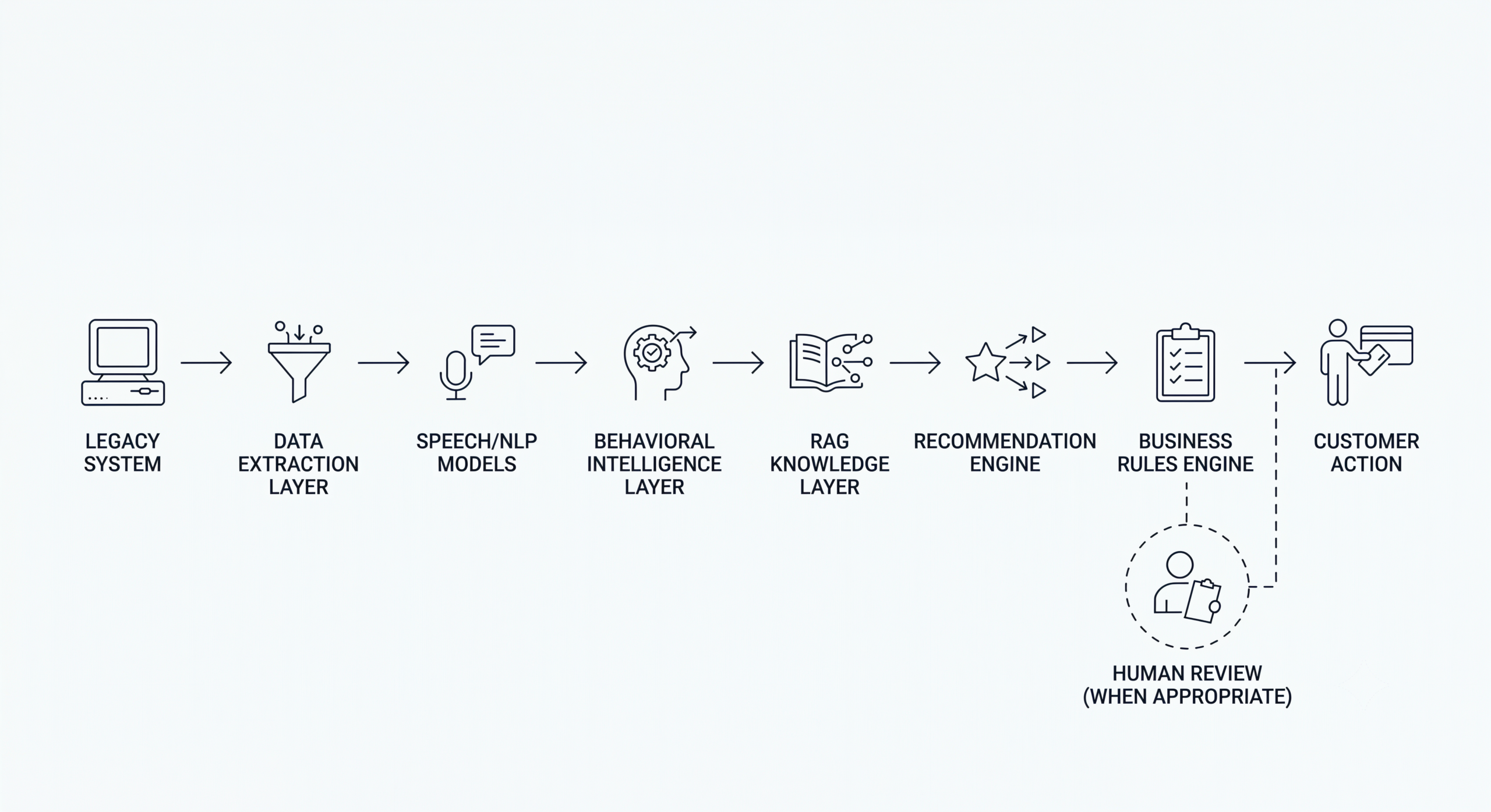
Within this architecture:
- The system generates predictions, insights, and recommendations.
- Deterministic business rules enforce regulatory requirements such as FDCPA, Regulation F, and TCPA.
- Human operators remain accountable for high-impact or customer-sensitive decisions.
This approach enables organizations to activate dark data while maintaining compliance, auditability, and operational control.
Final Thoughts
The future of collections is therefore unlikely to be human versus machine. Instead, it will be human and machine working together, with collectors serving not only as operators, but also as contributors to a continuously improving system of organizational intelligence.
Taken together, these steps represent more than a technology implementation roadmap. They describe a transition from transaction-based collections to intelligence-driven collections. These collections learn from every customer interaction and continuously improve over time.
Author Bio
Bhagyashree Vaidya is an AI Researcher and Business Operations professional with years of experience building data-driven strategies and solutions. Her expertise spans AI governance, intelligent automation, experimentation & analytics platforms, and enterprise AI adoption, with a focus on helping organizations integrate AI into complex legacy environments and unlocking intelligence from data silos. She holds a Master of Science in Information Management from the University of Washington and writes about AI governance, biases in AI, autonomous systems, and the future of enterprise intelligence.


