
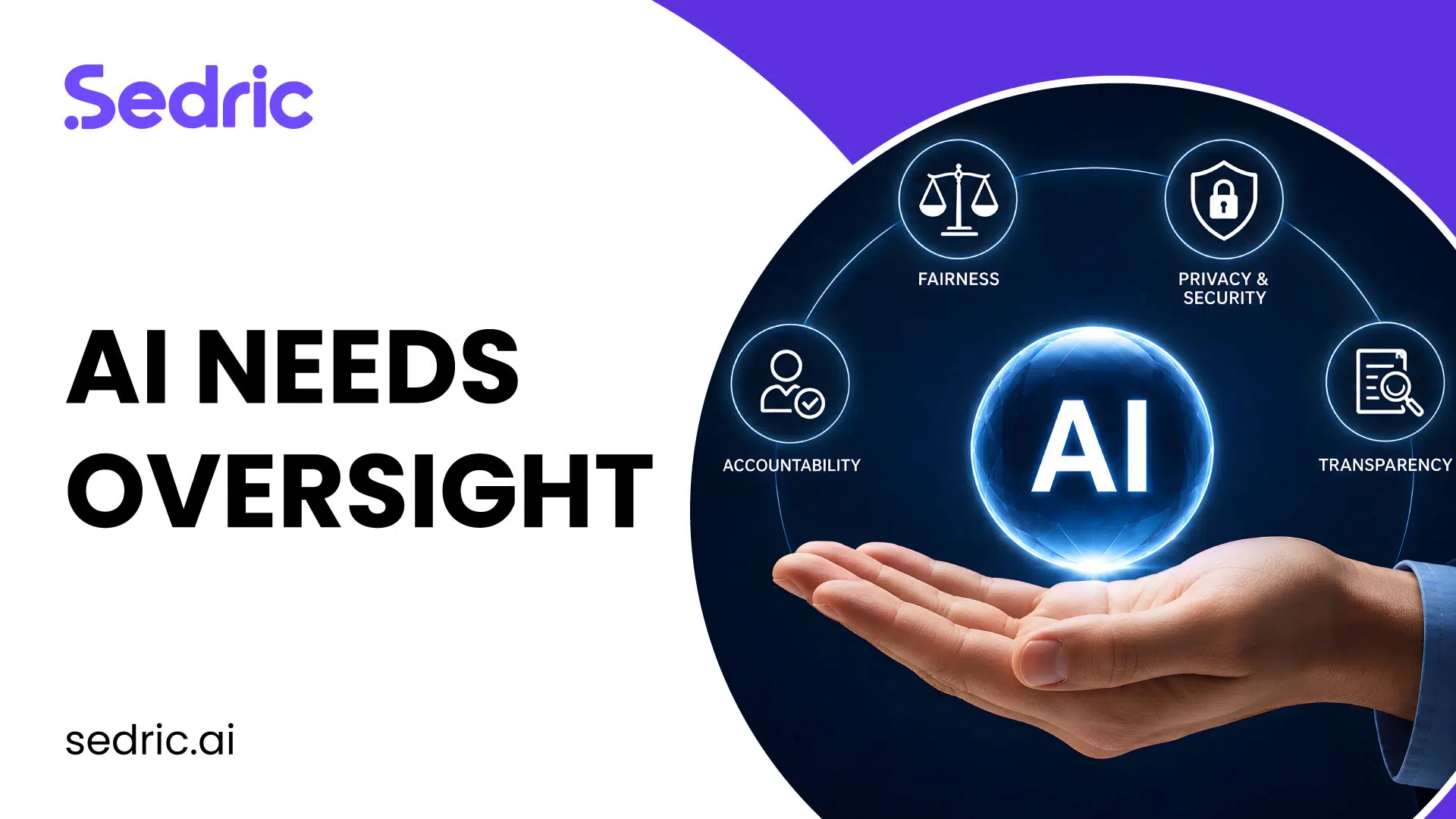
Scaling AI Responsibly Through Independent Compliance Oversight
As AI moves from proofs of concept into production, it is time for financial institutions to determine whether its behavior can be observed, measured, controlled, and corrected at scale.
This is especially important in collections and other consumer-facing workflows, where a single issue can be repeated across thousands of interactions far faster than in a human-only environment.
For this reason, independent AI compliance oversight is becoming one of the most important control layers in that operating model. The priority should be to ensure that as AI capabilities expand, the organization’s ability to govern them expands alongside them.
From AI Experimentation to Governed Production
The first major phase of enterprise AI adoption produced extensive experimentation. Organizations launched proofs of concept to test whether AI could improve productivity, reduce costs, or support new forms of customer engagement. It’s unfortunate that many projects never progressed beyond that stage.
The current phase is different. AI technology has matured sufficiently to support more sophisticated production workflows. As technical capability improves, however, another constraint becomes more visible: organizational confidence.
A model may perform effectively in a controlled pilot and still face barriers to deployment. Compliance and risk teams need to understand how policies will be enforced, how exceptions will be identified, how behavior will be monitored, and how problems will be remediated.
Without that visibility, a technically successful pilot can remain an operationally unacceptable risk.
Independent oversight helps close this gap by separating the question of whether AI can perform from whether the organization can govern that performance.
Why AI Needs an Independent Line of Defense
Separation of duties is a well-established risk management principle. The principle should also extend to AI.
Modern AI systems may include embedded safeguards such as prompt restrictions, policy rules, deterministic workflows, secondary models, or automated output evaluation. These mechanisms are useful, but they are not necessarily independent.
When the system generating a consumer communication and the system evaluating that communication share the same architecture, assumptions, data environment, or vendor ecosystem, correlated failures become possible.
A separate oversight layer provides a different function. It evaluates AI behavior against independently established policies, jurisdictional requirements, communication standards, product rules, and risk tolerances.
AI compliance orchestration for financial services addresses this problem by placing governance above individual applications. The underlying model can change while the organization’s control requirements remain consistent.
AI Agent Monitoring Must Account for Unpredictable Interactions
Consumer-facing AI introduces a variable that cannot be fully controlled, and that is the consumer.
Consumers may change subjects, ask unanticipated questions, provide contradictory information, or move a conversation into a scenario that was not represented during testing.
This creates a practical trade-off in AI agent monitoring for collections.
Narrowing an AI agent’s degrees of freedom can reduce opportunities for hallucinations or unexpected responses. The same restriction can also increase human escalations because the system has less flexibility to address unusual but legitimate situations.
Greater autonomy creates the opposite effect. More interactions may be handled without human intervention, but unexpected output cannot be eliminated entirely.
For governance purposes, hallucination risk therefore should not be treated as a simple yes-or-no test. The more useful analysis concerns the boundaries around autonomy.
- How much freedom does the workflow require?
- Which circumstances require escalation?
- How quickly can anomalous behavior be identified?
- What controls apply while the interaction is still active?
Those decisions should reflect the risk of the specific workflow.
An informational interaction, for example, may justify greater autonomy than a conversation involving disclosures, payment arrangements, settlement terms, or sensitive consumer circumstances.
This is why AI governance should be risk-based rather than uniform.
Preventive, Detective, and Corrective AI Controls
Once risk has been defined at the workflow level, organizations need a practical structure for controlling it.
A useful framework for AI risk controls for receivables divides controls into three categories: preventive, detective, and corrective.
- Preventive controls seek to stop or mitigate undesirable behavior before it becomes a completed compliance event.
- Detective controls identify potential issues while or after they occur.
- Corrective controls determine how identified issues are remediated and how recurrence is reduced.
These categories are familiar within risk management. AI changes their potential speed and coverage.
Compliance as Infrastructure for AI Adoption
The ability to detect and control risk changes the role compliance can play in AI adoption.
Compliance is sometimes characterized as a barrier because regulated organizations may delay technologies that introduce unfamiliar risks.
In practice, resistance often reflects insufficient information rather than opposition to innovation. A compliance team cannot confidently approve a system when it cannot observe its behavior or quantify the resulting exposure.
Better visibility changes that calculation. This is the practical value of compliance as an enabler of AI adoption. Instead of making a binary decision about whether AI should be permitted, organizations can establish specific conditions for deployment.
They can define monitoring requirements, escalation thresholds, acceptable levels of autonomy, remediation processes, and evidence required before an AI program expands.
Compliance consequently becomes part of the deployment architecture. This approach does not weaken governance. It makes governance more precise. It also creates a more productive relationship between risk and operational teams because both can work from observable behavior rather than assumptions about what the technology might do.
That shared visibility creates the foundation for evaluating compliance and performance together.
Performance and Compliance Are Part of the Same Operating Model
Within collections, AI operates inside a system involving consumer experience, productivity, account resolution, escalation behavior, creditor expectations, and regulatory requirements.
A preventive control that stops an inappropriate AI response may also prevent an unnecessary consumer escalation. Communication monitoring that identifies recurring compliance exceptions may expose workflow weaknesses affecting operational performance.
Consistent oversight can also provide creditors with greater visibility into outsourced agency communications while giving agencies clearer information about their own processes.
The goal is to recognize that both depend on visibility into what the system is actually doing. This is especially important when determining whether an AI deployment should expand.
AI Should Be Compared With the Current State, Not Perfection
AI is frequently evaluated against an error-free theoretical standard, while existing processes rarely receive the same treatment.
Human employees make mistakes. Quality assurance programs miss issues. Compliance teams operate with incomplete information. Long-established workflows can contain inefficiencies or control gaps that become accepted because they are familiar.
These limitations do not excuse poor AI performance. They define the baseline against which improvement should be measured. The appropriate comparison, therefore, is not AI versus perfection. It is the AI-enabled workflow versus the current operating model.
A responsible implementation should demonstrate measurable operational benefit while maintaining residual risk within defined tolerances. The analysis should account for both the risks introduced by AI and the risks that already exist without it.
Governance Capacity Will Determine AI Capacity
It is true that powerful AI will become increasingly accessible in the near future.
The more meaningful differentiator will be an organization’s ability to determine where AI can operate safely, detect when behavior moves outside acceptable boundaries, and respond quickly enough to prevent isolated problems from becoming systemic ones.
Organizations with mature oversight can make more precise decisions about autonomy.
Organizations without that visibility face a more difficult choice. They may deploy aggressively without understanding their exposure, or remain unnecessarily cautious because they cannot quantify it.
Neither approach is sustainable. As financial services move toward multi-model, multi-vendor, and omnichannel AI environments, competitive advantage will increasingly depend on the ability to observe it, govern it, and know when it is ready to scale.
This article was inspired by my recent conversation with Adam Parks on the Receivables Podcast, where we discussed “AI-Powered Collections Without Breaking Compliance.”
Author Bio
Nir Laznik is Co-Founder and CEO of Sedric.ai. His work focuses on artificial intelligence, compliance, and financial services, with particular emphasis on governance and oversight infrastructure for regulated organizations. He aims to help financial institutions manage AI-driven communications, operational risk, and compliance requirements while supporting responsible technology adoption.


