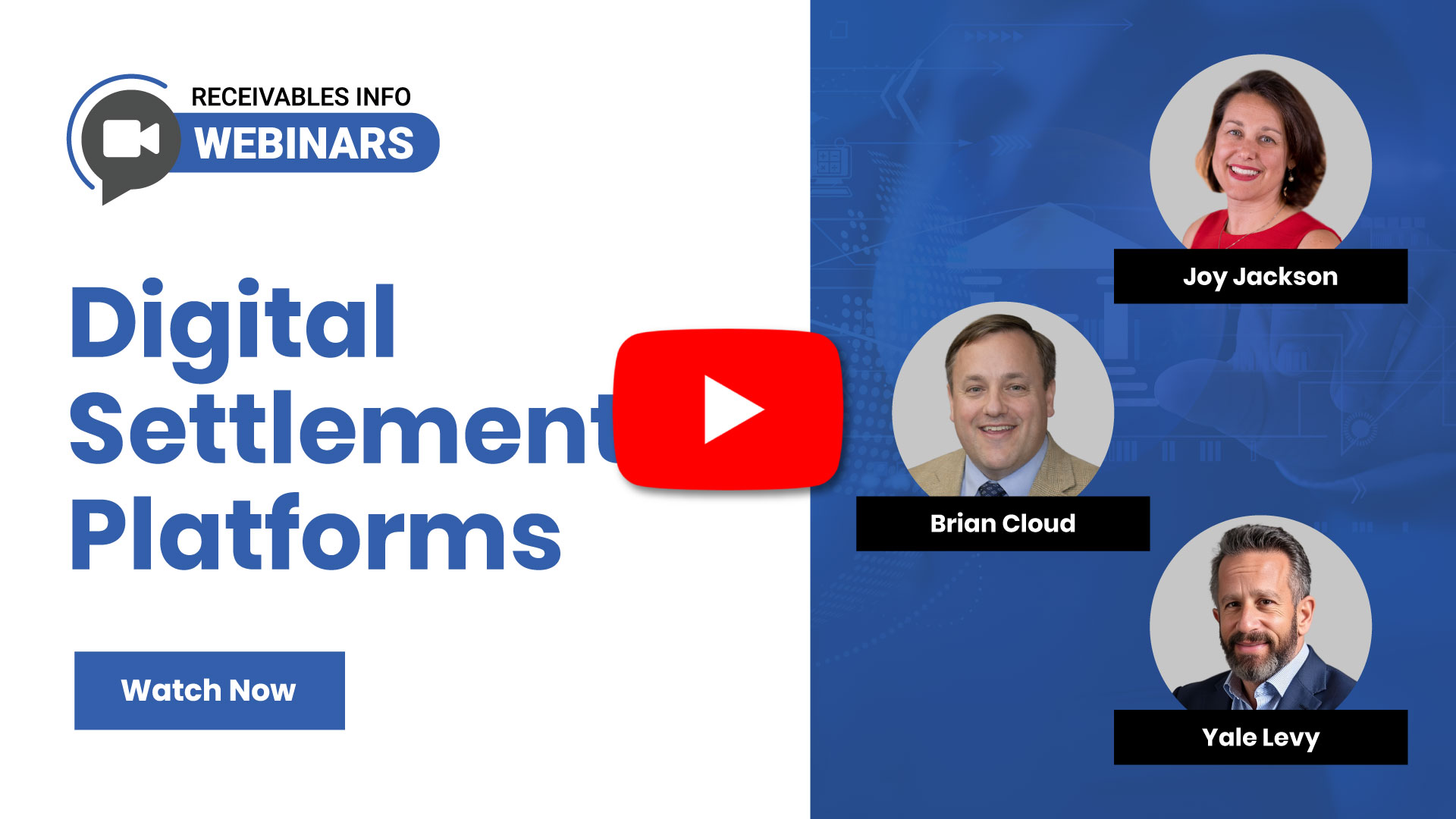
Adam Parks (00:00)
Hello everybody, Adam Parks here with another receivables webinar. Today I'm here with some good friends and as we talk about debt settlement platforms today, as I started taking a look at the technology, the understanding of that technology and its engagement from a creditor's side, I was a lot more skeptical until I talked to Joy Jackson and Brian Cloud here with us today as well as Yale Levy to talk with us about the settlement platforms and their experience engaging because I wanted to get a better understanding of what are the consumer options? What's the consumer's visibility into the debt collection space? And this experience for me has been somewhat enlightening for me to get a better understanding of how the world is ultimately viewing the debt collection space and how we can bridge the gap and improve the engagement. So thank you all for joining me today. Joy, starting with you, could you tell everyone a little about yourself and how you got to the seat that you're in today?
Joy Jackson (00:59)
Yeah, my name is Joy Jackson. I am the CEO of Faber and Brand. We are a creditors rights law firm based out of Missouri, but practicing currently in nine states. do just about everything that you can imagine and therefore are dealing with a lot of consumers and looking forward to discussing how we can meet the consumers where they are.
Adam Parks (01:20)
Awesome. Brian, think this is the first time you and I have done a broadcast together. Could you tell everyone a little about yourself and how you get to the seat that you're in today?
Brian Cloud (01:29)
Yeah, sure. I'm Brian Cloud. I'm an attorney with our managing partners, Cloud and Willis. We're based in Birmingham, Alabama. We also practice in Georgia and Tennessee. And I just see Solo as another tool that we can use to try to settle cases or get interaction with the consumers. So appreciate you inviting me to this.
Joy Jackson (01:49)
And Adam, think we both missed part of your question is how did we get to our seat today? And the same aspect is I'm also a consumer. And before I began my time as a creditors' rights attorney, I had my own experience as a young student dealing with medical bills and collection agencies. And I think that was really enlightening. And I think that's an important aspect for us to remember now that we're on the side of the seat.
Adam Parks (01:50)
Sure. Yeah I think it's a great point. We are still to this day consumers in so many different ways. Now, Yale, you've kind of worked on both sides of the equation. Could you tell everyone a little about your background and your perspective today?
Yale Levy (02:27)
Yes, my name is Yo Levy. I was previously a owner of a multi-jurisdictional law firm based in Ohio. It was called Levy & Associates. We operated in Ohio, Indiana, Kentucky, Maryland, and Virginia. End of 2022, I sold my practice and thought I was retiring. And then I got a phone call from the CEO of Solo asking if I'd be interested in being their client development director. I was hesitant at the beginning, once I met him and met the team, it was great. And I'm now on board as Solos, Director of Client Development. And it's been a really terrific ride so far.
Adam Parks (03:07)
And so it was kind of you that brought this to me earlier in 2025. And, you know, at first I was hesitant to say, okay, well, what is this platform? What's my objective? And let's, you know, kind of address the history of the organization as well. And I've had a chance to meet George as well. I did a podcast with him, which we can link below, where it was rather enlightening for me to see his perspective on what he was trying to accomplish for consumers and the route that he took in order to get there. So, you know, what, What's kind of been the challenge in terms of helping to introduce this product to the debt collection space beyond their general view of, let's call it debt settlement in general?
Yale Levy (03:46)
Right, so again, collections have been going on for hundreds of years. Since the beginning of time, people have owed debt and people need to actually pay their debts to keep the credit cycle going. In the United States, as we all know, most people use credit to buy things. They don't carry cash or have lots of money in their pockets to pay for things on the spot, but they use credit to do that. to keep the credit cycle going, you need to have consumers that use credit actually pay that credit back. So the way Solo works is instead of using telephones and friction and emotions to collect debt, we use technology. So there's all digital communications. People are able to settle their accounts voluntarily. Solo Settle is a consumer initiated collection platform where the consumer takes the initiative to reach out to the collector that's either suing them or collecting on them and try to settle their debts by making settlement offers that the law firm or creditor or collector can either accept or counter. So the collector is in control of what happens, but the consumer is so. Wanting to get this settled that they want to try to settle it because there was so much fear and emotions in that collection and shame in the collection process So by taking out that human interaction by talking on the phone by having long hold times and by feeling shame talking about the money they owe By using Solo Settle they could communicate digitally at any time they want in any place they want and try to settle their debts digitally by making offers and counter offers until an accept happens. And once that acceptance happens, the Solo Settle platform has the ability to have the collector upload a settlement agreement or settlement docs that we send to the consumer to review and sign by DocuSign and then they'll return to the collector to process and file with the court if needs be. So again, it's the efficiency, it's the lack of friction, it is the expediting of the process. Many people that use Solo Settle are able to get their debts settled in under a week instead of having to wait on hold for 30, 40 minutes, which is very common process if you talk to consumers on a regular basis.
Joy Jackson (06:04)
And if you take that on the attorney side of things, you know, I go back to my early days in this industry and being what we used to call a fondly, a road warrior with a lot of windshield time going from county to county across not just Missouri, but Arkansas and some of the other states that we practice in. And we're taking that time to go meet the consumers in court with a product and a tool such as Solo Settle. Not only can the consumers resolve these issues faster, but so can we as attorneys representing our clients and help the money in our clients hands faster and really spending hopefully less money. Maybe we're able to get it resolved without having to expend filing fees or other court costs. And then at least for the attorney side of things, maybe we're able to get it resolved without having to pay attorney time out of the office or travel or mileage or however your firm does that. And so I think that that is an important aspect to think about as well.
Adam Parks (07:00)
Well, your objective is communication, right? Like you're trying to invoke some sort of communication with that consumer, even if you're into the lawsuit process. And this seems like one of those triggers. Go ahead, Brian.
Brian Cloud (07:01)
Yeah, if I can. Yeah, if I could add, I mean, think if I could sit in my office all day and just you know, accept or make counters or reject. And most clients aren't going to reject. They're going to try to work things out with people. And like what Joy was alluding to, can't, can only be at one place at the same time. So like if you have to be in court, you can't be handling. And I think it's just a great technology play. And I think technology is where, you know, where the creditors need to be at, because it's, helps us to handle the, handle our clients. You know, we're not dealing with low volume clients. We're dealing with high volume clients. And if we could just settle cases because they care about compliance, but they also care about coordination rates and collecting money. And like I said, if I could just sit in my office and accept offers or get things resolved, it's a win-win for both sides. It's a win-win for the consumer who is probably eating them alive. Solo provides them with a mechanism to communicate with the creditor. And then here we are, we can't prompt it, we can't get people to join Solo, but when we accept it, we can have
Yale Levy (07:49)
You
Brian Cloud (08:12)
that communication with the consumer. I I've only, I think I've only had a handful. I know it's a lot more popular so far in other states, but I mean, think it's a great way to know that the consumer wants to resolve the case with you as well.
Joy Jackson (08:25)
And I think we often have, we'll call them repeat customers, repeat consumers. And so for those that are able to use a tool like this and find it successful, I know that you will see them coming back time and time again, maybe for different clients that you represent or maybe engaging with different law firms depending upon. The world is changing.
And the way that consumers want to communicate with us and the most efficient and successful way I think that we are all finding to communicate with others is digitally. And this is a tool in that space that needs to be looked at.
Adam Parks (09:00)
So we had a question come across on LinkedIn Live. And for those of you that are watching live, I encourage you ask questions. Let's participate in the conversation. And so this person said, who actually has consumers on hold for 30 to 40 minutes? And I would like to think that that also sounds crazy. However, the number one complaint that I read in Google reviews for debt collection organizations is either about not answering the phone, the amount of time that was on hold or falling into the IVR death loop.
So as much as I would like to say as collection agencies, or as debt collection professionals in general, we should have that buttoned up pretty well. I wish that we had it a little bit more buttoned. Some organizations are really good at it and they're managing those, even those Google reviews and they've got their five stars, but there's still so many organizations in our space that don't do it. And it wasn't really until I had done the, consumer webinar with George from Solo that I realized really just the perspective of the consumer. Like, cause we often don't think about what a jury of our peers really means. I'll, I think the attorneys in the room can kind of understand that. And until you have some of those direct conversations, sometimes you lose sight of what their perspective really looks like.
Joy Jackson (10:12)
Well, not to mention Adam, of course, none of us have an ideal of having a 30 to 40 minute wait time that's atrocious for any of us in this industry. And we definitely wouldn't want to be servicing our clients that way. But life happens and we have, you know, humans oftentimes answering those phones. Or if you don't, you have maybe technology glitches. Perhaps you have a holiday time and humans who call out sick or something like that. never know what could happen on any given day. And I'm also aware that that does happen from time to time in our industry as much as we don't want it to and make efforts to mitigate those circumstances.
Adam Parks (10:47)
But I talked about the Google reviews too. Like some of that might be exaggeration too. They were on hold for two minutes and they're calling in 40 minutes. So, you know, I want to find some, some level of balance to it, but I definitely, I mean, it's something that I combat every day. Go ahead, Brian.
Brian Cloud (10:47)
And I know that.
Joy Jackson (10:51)
Of course,
Brian Cloud (11:02)
Well, I think the thing about Google Review is it's just so easy to follow Google Review. Same thing with Solo. It's easy for them to get on there. I think the good thing for both sides as well is it allows you to get the documentation that you need to file on core. really, that gives the consumer knowing that it's resolved. It's not like they're having to wait for us to get the documents to them. It can be done on site. And I think also Solo has the capability to accept the payments. And I think that, you know, if you know that everything's being done and you don't really even need to, you know, because they want to just know that it's resolved as well. Like we want to get resolved, but the consumer wants to know it's resolved too. So they, you know, they can put this off as check this off as something they have to do, take care of and move on with it. So I think just the technology and the, you know, it's just, it's easy to get on just like it is. mean, we have some, you know, like you said, I think all of us have bad reviews about like, who are these people? I don't know why they're calling me. It's easy to get on Google, but it's just like, it's easy to get on here and resolve cases. I prefer, I think a lot of times people do Google reviews because they don't want to deal with it. And so they're trying to, so they can also get on here instead of this could be sort of a mechanism to resolve a case. I'll tell you like in my Alabama cases, we have, we have that ODR case. know we've talked about, can handle it, Yusa as well. And I've spoken to you with Yale before.
It's only in our small claims cases, it allows, it's similar to Solo, it allows the, it's only like 20 to 25 counties right now in Alabama, but it allows them to make offers to us. And I think any type of, any type of technology is great for both sides. And it's really good for the consumer because it's, you know, they're not having to call, be on the call waiting for 30, 40 minutes. They can send email whenever they want. They could be up, they could be up at three o'clock in the morning, they could do it at three o'clock in the afternoon. They can do it whenever it's convenient for to them, make the offer and then, know, since just like odds, it can be convenient for us, we might not get back to them for a day, but you know, we'll get back to them shortly because we want to get resolved just like they do.
Joy Jackson (13:05)
Yeah, I think that's an interesting aspect that when I originally spoke to Solo that they mentioned, as they said, we had a realization that the customers and consumers coming to them had a desire to resolve their debts and were looking for assistance in doing so. You know, they kind of, I think have made some pivots because of the realizations that they've had and really understanding their audience and the situations they're in. And I know that one of the beautiful things about Solo is I can sit there and see what my clients are getting percentage-wise on a settlement value. And I can tell you that it is higher on Solo than some of the other types of debt settlement companies or avenues that we're working on consumers with. And that's zealously representing our clients as we're to do.
Adam Parks (13:57)
Well, that is the underlying objective, right? But let me go back to the practicality from the beginning. So we were looking at, and I've worked with pretty much everybody on this call at one point or another, but what brought you to the conclusion of I need to go and try these tool sets? Like what was the, what was that decision factor for you that moved you towards, okay, I got to go start testing this. And what were you looking for in that evaluation?
Brian Cloud (13:57)
Yeah, and I'll
Yale Levy (13:58)
Yeah.
Adam Parks (14:24)
like making that decision.
Joy Jackson (14:25)
I'll be honest, Yale contacting me and having me look at the dashboard and the platform that already existed for consumers that were working with our law firm and talking about its capabilities. Then Solo and Yale included inviting creditors to join in the conversation with them to develop and make their product meet us as well where we needed to be. That was huge to me.
To recognize that, you know, honestly, to service their clients, it was smart of them to make sure that we were finding a place of mutual resolution. And that's what we're doing almost all day long. Yeah, sometimes we're actually getting into heavily litigated, disputed cases, but let's face it, we all know that over 90 % of our cases are finding a mutual resolution. And that is the most efficient and economical way to resolve your lawsuits, no matter what they are, including in our industry. And so they, it wasn't just lip service, the fact that they, they took the feedback that they were getting from various creditors and started implementing it and continue to do so. You know, one of the problems that we see, I just heard my paralegals complaining about it today, the multiple back and forth communications from powers of attorney and other debt settlement companies when we can on Solo Settle say this is our final offer. Like, take it or leave it. You're done, you know? That was, that came from the heart.
Adam Parks (15:49)
So you find that the communication process back and forth during that negotiation period or really any communication you're finding to be smoother and better documented in terms of what you then need to bring forward to bring the whatever matter to a final resolution. Okay.
Joy Jackson (16:09)
Yes.
Brian Cloud (16:11)
And I think with the death of companies, they, you They seem to have not always the best reputation with us. They'll make the offers of the 30, 40 % settlements. I think Solo is not really a it's not a debt settlement company. It's just a platform for communication between the consumer and the creditor attorneys or the creditors. And it just gives them the ability to get on there and make their, and I think I was receiving some answers before that were so. before even Yale was involved with the company. And I know it gave us, Yale gave us phone numbers and emails and we would use that information to try to reach out to them, because we're just trying to resolve cases. I think with bringing Yale on board, think that sort of brought, like he said earlier, he's ran a law firm, a collection law firm for years. So he knew the perspective of what we're looking for. Like I said, we're not looking to deal with that settlement company, we're looking to deal with the consumer who is just trying to resolve it and they initiate it. So we don't initiate it, but it's just a good mechanism for us to communicate. But I think it's really one that is something that's beneficial or really takes into concerns of stuff that the credit or law firm would be looking for in a platform.
Yale Levy (17:31)
And Adam, real quick. consumers are in control. So they are initiating this. They have the intent to pay something, which is great. And these are the kind of consumers that law firms and collectors want to talk to. And the settlement rates is all done by them. Solo has no influence over the collector. The collector makes all the, I mean, I'm sorry, the consumer makes all the decisions in the process about how much to offer and over what length of time.
Adam Parks (17:31)
soon.
Yale Levy (17:59)
Settlement offers we see are unbelievable. We see lots of people settling at 100%. Our biggest categories of settlements are in the 80 to 90 % area. So consumers want to get their debts paid. They want to take responsibility for the debt that they have, and they want to pay this off. So we are providing to collectors in law firms intent-ready consumers that want to pay and they want to pay something significant. Yes, we do have the one-off cases where people are for $100 and a $10,000 case, but that is the exception, not the rule.
The number of people paying 100 % of the debt or 95 or 90 % of the debt blows my mind some days about how much that is because these consumers want to pay. They have that intent to pay and they want to get this resolved.
Joy Jackson (18:54)
Yeah, and Brian mentioned the fact that Yale and he and I are all law firm owners or have been law firm owners. that dashboard that we keep talking about, I love being able to just periodically pop on there and see a firm-wide vantage point of how the attorneys and paralegals are resolving those cases in our office, that they're staying on top of them, and what those settlement percentages are.
Adam Parks (19:17)
So I want to come back to the dashboard in a minute and kind of talk about operationalizing it within a law firm. But, you know, we talk about these, these settlement parameters or these settlement offers that are coming in in that range. What do you think is prompting that type of differential compared to other channels?
Yale Levy (19:35)
It's because our platform takes out the emotion. They boil it down to dollars and cents. And when the emotion is taken out of the equation, people are able to make better offers because they understand that they have to pay this debt and that they have a lot from that or a collector on the other side that is they're making counter offers and acceptances. And it goes back and forth in a free market to get to a amount that the large formal collector can accept and that the consumer could afford to pay. So it is really a great experiment of success that these consumers were able to get these things resolved at this high rate.
Adam Parks (20:16)
I definitely would call it a success if we're talking about 80, 90, 95 % settlements. No question about that, but I'm curious about what is driving the consumer in that trigger. And taking the emotion out of the equation, like we've talked about the shame factor, and I've talked about that on a variety of podcasts and webinars, but just kind of thinking our way through how, you what is that consumer experience like? And the more that you can remove that emotion, I think probably the better off we are in terms of bringing everybody together towards a final resolution. Now, Joy, you had been saying something about kind of how you're looking at the dashboard because you're running a firm that's in a lot of different jurisdictions, right? You've got a pretty wide geographic coverage area. So as you're talking about it from the perspective of a larger firm, how are you able to leverage this technology within your organization itself? Is there a single point of contact? everybody is going in, what does that look like from a larger firm perspective?
Joy Jackson (21:15)
You know, there's definitely more that can be done here. Right now, where we're at, it's pretty interesting. we have attorneys, young attorneys, middle-aged attorneys, attorneys that may be older. And so they all have different ways that work for them to be successful. So some of our attorneys are still engaging through email platform, the email communication with Solo that Solo can facilitate as well you know, paralegals that they work very closely with and working on these. Some of the attorneys are going on to the dashboard and doing it themselves. So it allows for flexibility within your staff, which I think is interesting and important. There's probably some more automations and other things that we could develop is what I'm indicating too. I'm sure there's more room to go forward.
Adam Parks (22:00)
There's always room for automation, you've still got a doubt. So you still have a bird's eye view of what is happening across the entire organization. And then the individual attorneys are able to handle the cases that relate to their work.
Joy Jackson (22:14)
Right, from my unique seat, that's what I want to be seeing is how is it working, is it working, and what else might we be able to do with it in the future.
Adam Parks (22:24)
Now, Brian, from your perspective, how do you engage with or how does your firm engage with the platform?
Brian Cloud (22:31)
Well, mean, like I said earlier, we haven't had as many, but the ones that we have, we actually, we have attorneys that handle certain clients. And so they would be segmented out that way. We haven't automated yet. We just have them get on there and take care of the communicating with the consumer for the ones that they're responsible for.
But I know you're a big fan of automation and we're moving in that direction. I think that's probably something that all collection law firms should be looking at as far as somehow getting solo to communicate with our collection software system.
Adam Parks (23:01)
Fair enough. mean, I think we're all looking for whatever opportunities we can to automate processes. But I think one of the biggest challenges we have as an industry is engaging the consumer to communicate. And when we can get into a framework of being able to communicate, I think is where we could start solving some of these problems. As law firms that have deployed this and have started kind of going through the process of engaging with consumers through the platform, Have you seen any additional risks or do you perceive any additional risks that kind of come with the benefit? There's always a risk versus reward probability. We can clearly talk about the rewards, but have we seen any increases in risk?
Joy Jackson (23:43)
I don't know about increase in risk, but we must not forget the risks. Just because you're communicating in a different form doesn't mean that the same rules don't apply and that the risks don't still exist. But I do want to go back, Adam, and kind of touch on something that you were speaking about with the communication aspect. And Yale mentioned this earlier. Everything is driven by the consumer. And that means whenever you're talking about being able to use this technology to drop a consent judgment or something of that nature for the consumer to sign off on. You're not waiting for this third party to like, you know, I got to talk to this guy and I got to talk to that guy and I got to get it back. You're not waiting for it to get lost to the United States Postal Service. It is much more of a direct interaction, I feel like, with the consumer, which expedites and I think leads to increased agreed judgments in those situations.
Adam Parks (24:35)
I think that makes a lot of sense. had another comment that came in about how businesses change and how Solo has kind of evolved their business model here to be that communication point, which I think is insightful. As you look at or as you think about how others may be avoiding the technology at this point from a law firm perspective, what message would you have for others that are kind of evaluating this from the outside?
Brian Cloud (25:01)
Personally, I don't think there's much of an evaluation. think it's another tool to resolve cases. You're not going to just use Solo. You're just going add it to what you're using already. It's just another way to communicate with them communicate with the consumer and it's really prompted by them and I'll go back to something I mentioned before when we were talking. I know there was a study that was done in like Maryland about I think was like Baltimore County or something. I don't practice that but it was brought to my attention and they were talking about the fact that they're looking at all the default judgments. Like when we file cases and we get them served, don't want, we're not looking to get default judgments. I mean we'll take them. We don't want to get resolution of the cases. We want to get that we want to be able to say we can satisfy the judgment or dismiss it because it got resolved. That's what we're looking for. So if there's a way that we can use technology, a phone, letter, anything to get resolution on cases, that's what we're looking for. We're not looking for paper judgments. We all have tons of those that we just have in our system or scanned in our system or that's not beneficial for our client, it's not beneficial for the consumer. So really any type of mechanism that we can communicate with the consumer is great for all collection law firms.
Joy Jackson (26:16)
Yeah, we're looking for results. And this is a tool that gets your results.
Yale Levy (26:21)
and communication. Correct.
Adam Parks (26:21)
And you can't get to that result without a communication, right? Like it comes back to what can I do to prompt the consumer to actually communicate with me? And I think that's how we got into self-service and digital technology as an industry to begin with, because will they respond to a text message? Will they respond to an email? Will they respond to a phone call? Will they respond to smoke signals? Like whatever I can do to try and get the consumer to engage in some sort of a conversation, I think starts moving things down the path. Now, I'm
Joy Jackson (26:48)
Bye.
Adam Parks (26:49)
Curious, Yale, as we think about and we talk about these settlement rates in that 80 to 90 % range, do you think that part of that is, or do you see a difference in those settlement rates depending on where an account is in its life cycle? Meaning, if it's already gone to litigation and we've already got suits filed versus if maybe a collection agency was engaging with the platform without the threat of litigation as part of the discussion.
Yale Levy (27:17)
of course. So we do have a number of agencies on the platform already, and their settlement rates are lower because they don't have that threat of the lawsuit or the pressure of the lawsuit on the consumer. But on the legal side, which is what I know the most about. Consumers want to get these cases settled. They do not want garnishments. They do not want bank attachments. They want to get the cases resolved. They want to communicate digitally because they don't want to talk to people. They don't want that friction. They don't want the emotion. They don't want to experience the shame of talking about why they haven't paid their debts. So the Solo Settle platform is a communication model that allows people to communicate digitally without fear without shame and without friction. And that's what people like. And like my kids who are 24, 22, and 19, they tell this to people all the time. They never pick up the phone. Their entire communication skills are texting and email and digital. So why would we expect the younger generations to try to settle their debts over the phone when they don't have those abilities and skills to do that? And this is what Solo Settle provides.
Brian Cloud (28:29)
And you know, also it's a neutral site too. The difference also is the fact that there's not a There's not a bankruptcy or consumer attorney behind it. It's just, it's a neutral platform that, you know, and they're not going to be, you know, they're not going to be offering 30, 40 % that, you know, we're not really going to entertain. It's, it's just providing a platform for people to communicate. I think that's also probably the difference in why the, you know, the numbers are, are more reasonable where, where results can happen and things get settled because it's not, you know, we just, we're just going to ignore the 30, you know, those consumer attorneys that are trying to just, you whatever, they don't, know, there's not, they're not, you know, trying to, we're trying to get a reasonable resolution that's win-win for both sides, not just for themselves, so.
Joy Jackson (29:07)
Low ball. you
Yale Levy (29:19)
Correct. And then we educate them, Adam. We tell them if you don't answer your lawsuit and a default judgment happens, you get court costs, you get interest, you get garnishment fees, you get bank attachments, it drives up the cost of the debt. So if you could settle for 75, 85%, you're winning. Because otherwise, if a judgment is taken against you and attorney's fees might be awarded, court costs are added in, garnishment costs are added in, you're $5,000. debt could easily be $7,000, $8,000 in three to five years. So if they could settle, right? Yeah, so again, that's what we try to sell to consumers and educate them about the process, about what happens if a judgment is awarded versus settling the case. So we tell people your best option is to settle unless you have a true defense or issue with the debt, but most people don't.
Adam Parks (29:54)
Yeah, post judgment interests.
Brian Cloud (29:57)
Yeah.
Joy Jackson (30:15)
You know, a common theme through all this discussion that I'm hearing is evolution. I think we have an evolution of Solo Suit I you know, we all know the days where we saw solo now, but it used to be Solo Suit and we would have, you know, them helping to file answers or counterclaims. And I think it's important that we address that and that we see the evolution that solo has come to where, I mean, I wonder how, did you have happy consumers when they got into a more litigious situation or? have more happy consumers now and they're able to resolve a debt and have it off their shoulders. I go back to the evolution of society. think Yale brought up a good point. I too often look at and observe my children who are of similar ages and interacting in the same way and the evolution of how we're practicing law and communicating with people.
Yale Levy (31:05)
And the efficiency of digital communication, as Joy and Brian both know, is a hundredfold. I mean, it's so much easier to digitally communicate via SoloSettle. It takes 15 to maybe 60 seconds to make a response compared to talking on the phone with somebody for 20 minutes to understand what their issues are, get through the validation process, get their budget information. We collect all that for them in SoloSettle. We provide it to them on the platform. They can see it. They can see what they're
Yale Levy (31:34)
situation is, they can see what their budget is and their cash flow statement and SoloSettle does a great job of memorializing all the communications back and forth. So it's there for the law firm to see, the consumer to see, and there's a documentation of every step of the process.
And then every time a check is made, a payment is made, we let the law firm know that a payment has been made. We put it in the notes so they see what the date it was, how much was paid, and then Solo Settle sends them a check or ACH is in the money.
Adam Parks (32:04)
I short-cutting the process. Now, when we talk about the digital communications, I definitely agree that, and it's been my experience that the consumers want to communicate with the collector, generally through the same method and how they took the loan to begin with. So if you're talking about a younger online consumer, they want to do self-service, text message, email, if they physically went into the bank and filled out a credit card application, which I feel like is a really specific generation. But if that's the case, then they probably want to be communicated with over the phone.
Preferably a rotary. But I think people tend to go back to whatever kind of technology, however they took out the loan is I think is how they want to communicate with the creditor and it's how they ultimately want to communicate with the collector. I think we've seen that for a couple of years now in terms of its evolution. But these younger consumers, especially as we're talking about FinTech debts, auto loans, because so much of that is happening online. I mean, I've never considered the day of actually
Joy Jackson (32:34)
you
Yale Levy (32:35)
You
Adam Parks (32:59)
purchasing a vehicle without ever seeing it, but you do see that online every day, right? Like car gets delivered to their house. So I think as the world is changing, it's important that we continue to evolve with it and that we're gonna communicate with those consumers in the channel in which they're gonna be most comfortable. Now is the only thing that we're, right? What was the only KPI now? Everything.
Brian Cloud (33:10)
Yeah.
Joy Jackson (33:16)
Their groceries are getting delivered to their house, their entertainment is getting delivered to their house and now they're solving their lawsuits from their kitchen or living room.
Brian Cloud (33:29)
Well, Adam,
Adam Parks (33:29)
Alright!
Brian Cloud (33:30)
what's the average age of people that go into a bank? I I bet there's a lot of 20 year olds that have never even been into a bank. But you might have this. You have a lot of 60s and 70 year olds that probably go into and that's just what they're used to. And that's what they want to deal with. But you have a lot of people that don't want to, you know, that's just not how they're how they communicate. So.
Adam Parks (33:36)
I concur with that assessment.
Yale Levy (33:37)
You
Joy Jackson (33:39)
But I don't think we just have.
Adam Parks (33:49)
The majority of people I see in the branch are underbanked, right? They're people who don't have a bank account or that capability of doing some other kind of digital payments. So they're there to physically cash a check.
Brian Cloud (34:00)
Yeah.
Joy Jackson (34:01)
And I don't think we want to discount the fact that people do change a little bit with technology. I'm sure that most of your research is matching up with that, Adam. But I think about even my grandparents who were born with party lines. They were of the party line. And now they can text. And I'm going, OK, that's amazing.
Adam Parks (34:17)
You Yeah. The people will look, the people will evolve with the technology, but I think that there's a clear correlation between how an account is originated and how the consumer wants to communicate at the end. And I think the law firms have been slower through the years to adopt new technology and that may be changing now. And I think there's different use cases for the different types of debt collection organizations, but a lot of law firms have not been forward thinking and getting off of the phones and into digital texting.
Joy Jackson (34:30)
slow.
Adam Parks (34:53)
email management and all of that. So I think having a platform that kind of closes some of that gap for some of the firms. Look, I know your firm is significantly more advanced in terms of how you're communicating in that outbound effort, but not everybody's quite there. So I think being able to kind of fill those gaps and provide the consumer with one of those pieces. Now, the other thing that I think is interesting when I think about the methodology here for bringing an account to resolution, is that you can continue to reach out to that consumer, right? Repeatedly throughout the process, the credit, the originating creditor tried to reach them and resolve this. There's probably, there may have been an agency placement between there, but SoloSuit is taking a different advertising approach. They're not necessarily going through that same, they're not going to SoloSuit because they saw you on the credit report. SoloSuit is kind of rounding up some of these consumers on their own, through their own content to bring more people to, potentially the table for these settlements than we would have seen otherwise. Am I thinking about that the right way,
Yale Levy (35:56)
Yeah, that's totally correct. We do a lot of SEO, SEM, paid search that drive consumers that are being sued or being collected on by collection agencies to educate them about what to do when you get that notice. What does a summons and complaint mean? What's the deadline to file an answer? And we try to educate them to provide them some tools to understand the legal process. Many people that are not loyal to us on this call, it's a very confusing, archaic system that is very intimidating to the uneducated person provide them with videos and blog articles and to help them understand what is going on and what they need to do.
Joy Jackson (36:38)
Yeah.
Adam Parks (36:38)
While educating them is always an important part of the process.
Joy Jackson (36:41)
Sounds like taking some of the fear out of it so we can get down to the nuts and bolts and the objectives of resolving the matter.
Yale Levy (36:41)
Correct. As we all know, the worst thing to do is have somebody stick their head in the sand and hope it goes away. That is absolutely the worst decision to make.
Adam Parks (36:56)
It never goes away, right? Like debt collectors never just disappear, but by engaging in the conversation, you can actually get closer to a resolution that makes sense.
Yale Levy (37:00)
Correct.
Brian Cloud (37:06)
And they found like, again, I...
Yale Levy (37:06)
That's why we all go on Brian.
Brian Cloud (37:09)
They finally get in touch with you after you file a garnishment, which is, you know, towards the end that they should have gotten, know, that they should have hopefully gotten, you know, start the communication the way before that where they don't have as much, much control. And, know, at the beginning they have control and then as time goes on, they lose that control with the legal processes. But again, we're just trying to get it resolved. I mean, really if they call it any point, it's fine. It's better than, you know, like Yale said, it's better than just putting your head in the sand and not doing it ever. So.
Adam Parks (37:36)
Well, they just put their head in their sand. They're going to end up with a default judgment. You're going to get a garnishment or there's going to be an asset or something else at a different point in their life when they're not at the top of the mind. And it's going to feel like a surprise. every time that I talk with a consumer about resolving their debts, the number one piece of advice I have for them is communicate. Like hiding helps nothing and definitely don't just avoid the fact that you're being sued.
Adam Parks (38:03)
Like you need to talk to that law firm. Like you need to engage in some level of communication. Because otherwise it is a default process.
Joy Jackson (38:10)
And let's not forget about how much the courts appreciate and like it when we're able to go in and say that we're dismissing a case because it has been paid in full or settled in full, or to receive that signed mutually agreed upon consent and judgment versus the defaults or setting trials and litigating further.
Yale Levy (38:30)
The theme of this webinar should be communication, because that's what it all comes down to. We need consumers to communicate with the collectors. Collectors can't get people on the phone. They send letters, they make phone calls, people don't pick them up.
Adam Parks (38:35)
Breathe.
Yale Levy (38:45)
and they kind of feel comfortable with Solo to communicate digitally and that's kind of what our spices is. We have something that makes the consumer comfortable to actually sit down, communicate electronically with the collector or the law firm and try to get their case settled. And when they do that, when they communicate, guess what? It happens. They get their case settled, they avoid garnishment, they avoid bank attachments, and sometimes they even avoid a judgment.
Brian Cloud (39:13)
By the time it gets to us, the creditors and the agencies have probably already called it a hundred times or sent tons of letters. Again, like you guys said, it always goes back to communication. There's so many different opportunities. But if an email or a platform can prompt people to settle cases, think that's great. Solo is just like I said, it's just a tool that you use to try to settle cases.
And it's a fact, mean, it's, that's why when you said, ask the question, is it, know, what made you go to it? It's like, I don't think there's really a decision, because it's just an extra tool that you can help resolve cases. Because we have so many, we have a lot of cases, we have a lot of accounts to handle, you know, whatever way we do it, whether it's letter, email, or text, or solo, it's just another opportunity to settle cases and resolve cases.
Adam Parks (39:59)
From your perspective, this is another communication method like an email, text message, phone call, or accept the settlements through that platform. communication is key. I don't know how else to put that. That's the number one piece of advice that everyone should be giving to consumers as it relates to debt collection. mean, that's not what they see on TikTok. However, it is the most realistic resolution for them is to have some sort of communication.
I mean, some of the stuff that I see on social media in terms of the other advice that they're getting is scary to say the least. ⁓ saw a video last night about, God, is it something about, never pay a debt buyer because they bought the debt and now they owe it. Like, I mean, and then they put like a, they'll pull like a US code or statute like listed there, which clearly is not even remotely accurate. But.
Brian Cloud (40:30)
Yeah.
Adam Parks (40:47)
getting them past that and into a real communication channel, I think is the underlying objective.
Brian Cloud (40:47)
You're probably It probably came from ChatGPT They probably just made it up some code to put out there.
Adam Parks (40:59)
Honestly, it wouldn't surprise me at all because some of them, I mean, I go out there looking for this kind of content because I really wanted to understand like what is the consumer seeing out there online and what decisions do they have? So it was really at the beginning of 2025 where I started looking at like behavioral patterns and saying, how does behavioral analytics play into what we do as a debt collection industry? And how can we start leveraging behavioral science and just trying to understand it? So I spent a lot of time over the last year with that settlement organizations, credit counseling, and just trying to understand kind of the debt relief space and what does that all mean in terms of the options for the consumer. And then doing the webinar with George and looking a little deeper at having like these direct conversations with the consumers, it's given me a lot more perspective over the last year as to what is the consumer actually dealing with. And I think that the online presence and being able to being present on social media and the other places where the consumer's going to check it because they're gonna get an email, they're gonna get a text message, they're gonna get a lawsuit, they're gonna get knock, knock, knock service. Now I've got this, what's the first thing I'm gonna do? I'm gonna go look at the company that's suing me, I'm gonna go look at the law firm that's suing me and I'm gonna try to understand who these people are. And so having some sort of an intermediary in the process, like a like having a SoloSettle in the process, I think could potentially add additional value because now they're feeling like there's a referee in the room and maybe coax the consumers out of their shell a little bit and into that communication channel where we can have a real discussion.
Joy Jackson (42:33)
And again, going back to the time and the availability of the platform to communicate with us if our offices aren't open to answer phones or not during normal business hours or things of that nature.
Adam Parks (42:44)
video.
Yale Levy (42:45)
And to pick up after Adam's about a referee, we call ourselves a neutral mediator. So we just provide offers back and forth, counter offers back and forth between the consumer and the law firm or collector to try to get cases settled. We don't tell the collectors, we don't tell consumers what to do and we don't tell collectors what to do. It's all a free market. We will pass through any communication that we receive.
Adam Parks (43:07)
So I know we've got a couple of people here watching live. If any of you have additional questions you'd like to ask, we're coming into kind of the tail end of our discussion today. So I wanted just kind of open that up if there's any additional questions that anybody wants to introduce. But, know, short of that, Yale, any final statements or message that you would put across to our audience today in terms of what your objective is and how your company has evolved? where it is today.
Yale Levy (43:34)
Yeah, our objective is to tell people that aren't using solo saddle. that we're not the solo center of the past. have done away with motions to compel arbitrations. We have done away with debt validation notices. We are truly now a neutral mediator. We do not take a consumer side. We do not take a collector side. We are here to help facilitate meaningful and productive communication between collectors and consumers and consumers back to collectors. It is all consumer initiated and consumers have the intent and desire to pay off these bills and we are out here today trying to get law firms and collectors to further engage with Solo Settle like Joy and Brian does and lots of law firms and collectors around the country are doing. They see how easy it is. There was absolutely no cost to collectors to use the platform or law firms to use the platform. The consumer is so interested in getting these cases resolved, that they're willing to pay a small tech fee to help underrate the cost of the technology in our platform to try to settle their debts. It's been a really breath of fresh air for me. Solo is a true tech startup. Things move very fast, as Joy and Brian have said. We implement changes and suggestions every two weeks. We hear what the law firms want. We hear what the consumers want. We do lots of consumer interviews. We talk to collection agencies and law firms every day to say, hey, how can we make this better for you? It is a evolving platform that is cutting edge technology, really smart engineers from Stanford and other places around the country, and they really know what they're doing, and it's been great.
Adam Parks (45:23)
So, yeah, I did have, as you were talking, had someone ask about the cost. So just to make sure that we heard that correctly, that there is no cost to the collection side. The consumers are paying a small technology fee on their side. And so there's no, really no cost on the creditors side.
Yale Levy (45:32)
Correct.
Adam Parks (45:42)
I just wanted to make sure I hit that one more time since it was a specific question and then didn't get lost into that response because you covered a lot of pieces there as well. So Joy, Brian, any advice for those that are watching in terms of those that are kind of currently evaluating what might come next?
Yale Levy (45:45)
I appreciate it.
Joy Jackson (45:59)
You know, I would say that earlier at the beginning of this conversation, Yale spoke about credit and the individuals who have a need for credit. But credit is not just there for those who don't have cash. It's there as a tool. And even those people, you know, miss something or get delayed or procrastinate. And even those people are going to be able to utilize Solo to hop on and be like I need to take care of this real quick. Getting involved with Solo Now, having a voice in the room to make it better for your firm, for your clients, for your agency, I would highly recommend.
Brian Cloud (46:38)
And I'll add, I mean, think it's for the collection firm, collection agencies, it's really like a no-brainer because it's not really. It's just a way we can communicate. For consumers, think it's a great way. I I would sign up for something like this because I think it provides them with the ability to communicate with someone on the other side that's going to be able to resolve your financial issues. Where you have a say in the matter. Because when you make that offer, it's going to be a yes, a no, probably not a no, and then most likely a counter offer. And there's not really any
you know, it's just a way that they could gauge where they're at and figure out how they can resolve it. But if you don't do anything, you're never going to get it resolved where you have any control of it. might be able to do it through solely, you might be able do it at court, because a lot of times courts are trying to force the parties to resolve cases. But it just gives you that way where you can sit at home and make an offer and hopefully try to resolve matters, financial matters that you're having to deal with.
So I think for our side it's a no brainer, for the consumer side it's a way that they can resolve things that probably negatively affecting them where they can actually have some control with the results.
Joy Jackson (47:51)
And there's not a lot of room in this communication platform for an efficient conversation. We all appreciate being polite and nice and talking about the weather, but this platform cuts straight to the point of what we're trying to communicate about. And I think that's another important aspect we haven't touched on yet.
Adam Parks (47:57)
Not a lot of additional story.
Yale Levy (48:09)
Yeah, Joy, that's a great point. The efficiency of it is phenomenal.
Adam Parks (48:13)
It sounds like now is the time for people to reach out to Yale and have a direct conversation on how they could leverage Solo for their own creditor or collection businesses. But thank you guys so much for joining me today, coming on, sharing your insights. It's been a fun discussion, which I knew it would be when I was going to have the three of you to talk to today.
Joy Jackson (48:36)
Thank you for having us and taking time to look into it more, Adam. We appreciate it. ⁓
Brian Cloud (48:40)
Yeah, appreciate
Yale Levy (48:40)
Yes.
Brian Cloud (48:40)
the invite.
Yale Levy (48:42)
Yeah, thank you, Adam, for doing this.
Adam Parks (48:45)
Absolutely. For those of you that are watching, you have additional questions you'd like to ask me, Yale, Brian, Joy, you can leave those in the comments on LinkedIn and YouTube and we'll be responding to those. I also saw some comments here that I started tagging Yale in so he can reach out to you directly for an additional conversation. But thank you so much everybody for joining us on LinkedIn live today, coming to you live from South America and Brazil and looking forward to seeing many of you at the RMAI conference coming up here in just a couple of weeks.
Thank you everybody and we'll see y'all again soon. Bye.
Yale Levy (49:16)
Thank you, Adam. Thank you, Brian. Thank you, Joy.